Some commissions arrive as a program — square footages, adjacencies, a budget. This one arrived as a legacy. The Central Coast Jet Center, now taking shape at Santa Maria Airport, is a new chapter in a story shaped by three generations of Kunkle family aviation history, and designing it has meant holding that history and a demanding operational brief in the same set of drawings.
A legacy measured in flight hours
The project is rooted in the pioneering spirit of Jim Kunkle, a World War II pilot whose service and lifelong passion for flight helped establish general aviation on the Central Coast. That inheritance set the tone for everything that followed. Aviation culture prizes discipline and craft — checklists honored, machines maintained, nothing left approximate — and we understood early that the architecture would be judged by the same standard. A building for people who fly should be as considered as the aircraft it shelters.
Operations set the plan
The facility is a new 38,642-square-foot, two-story building intended to establish a new benchmark for FBO capability and experience in the region. At its core is the commercial aircraft hangar, engineered to support a remarkable range of aircraft — from high-end Gulfstream clients to military platforms such as the F-18.
A hangar is architecture at its most honest. Its clear spans are dictated by wingspans, its height by tail clearances, its openings by the machines that must roll through them; there is no disguising a dimension that does not work. So the planning ran from operations outward — from the apron and the hangar floor to every space that supports them — rather than from a facade inward. When the functional logic is resolved that directly, the building's form can afford to be calm.
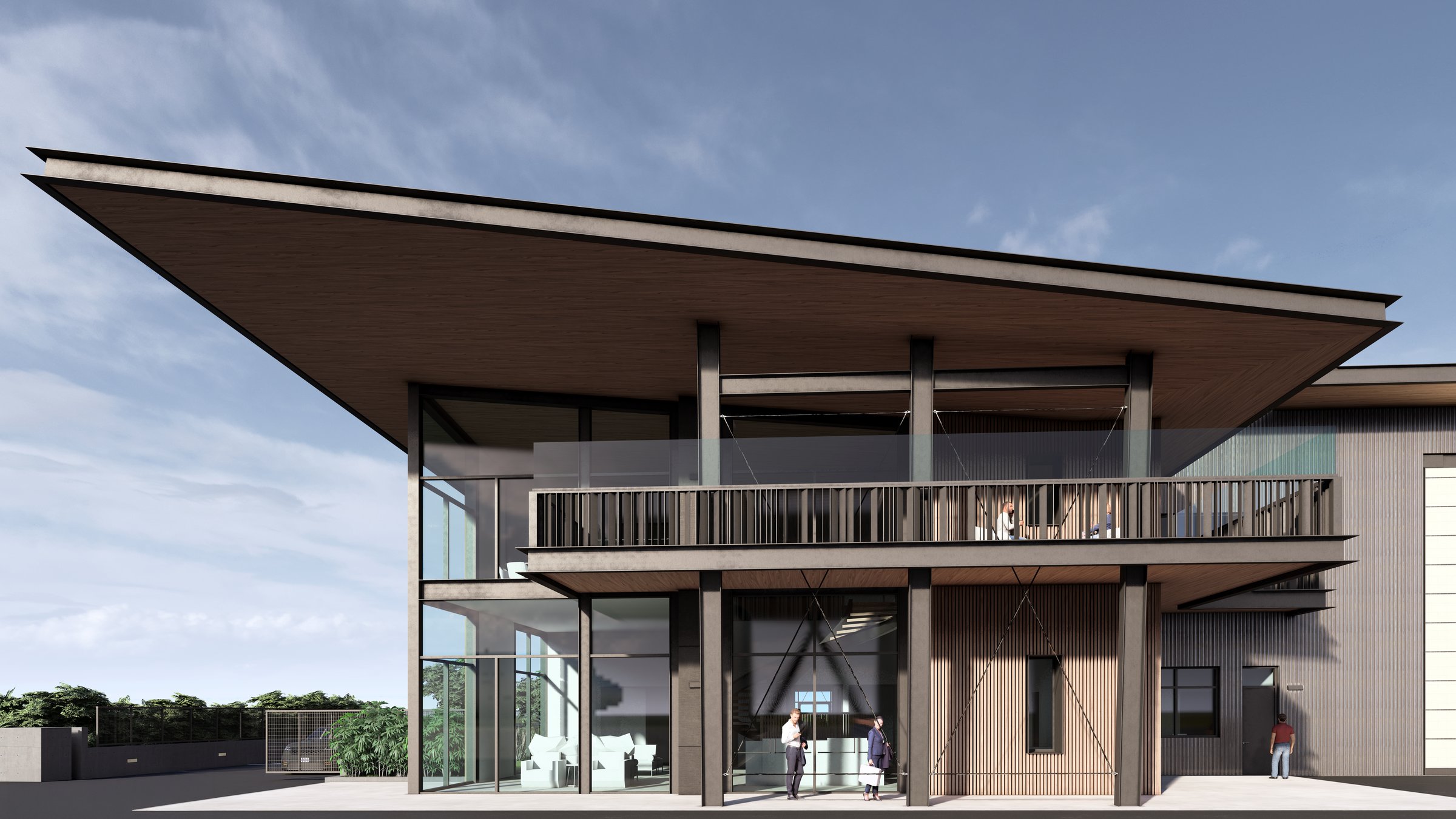
The winged roofline over the two-story facade at Santa Maria Airport.
One roof, one operation
Alongside the hangar, the building carries 13,566 net square feet of corporate headquarters and office space — and the word alongside undersells the intent. The offices are not an annex bolted to a shed; they are integrated to unify operations, client services, and executive functions within a single cohesive environment. A pilot checking weather, a client waiting for a flight, and an executive running the company share one building with one character, and the design works to make those overlaps feel natural rather than accidental.
The two-story section does quiet work here. Ground level belongs to movement — arrival, client services, the life of the hangar floor — while the upper level takes the longer view across the airfield for the headquarters functions. Stacking them keeps the entire operation within a few steps of the apron, which is, after all, the point of an FBO.
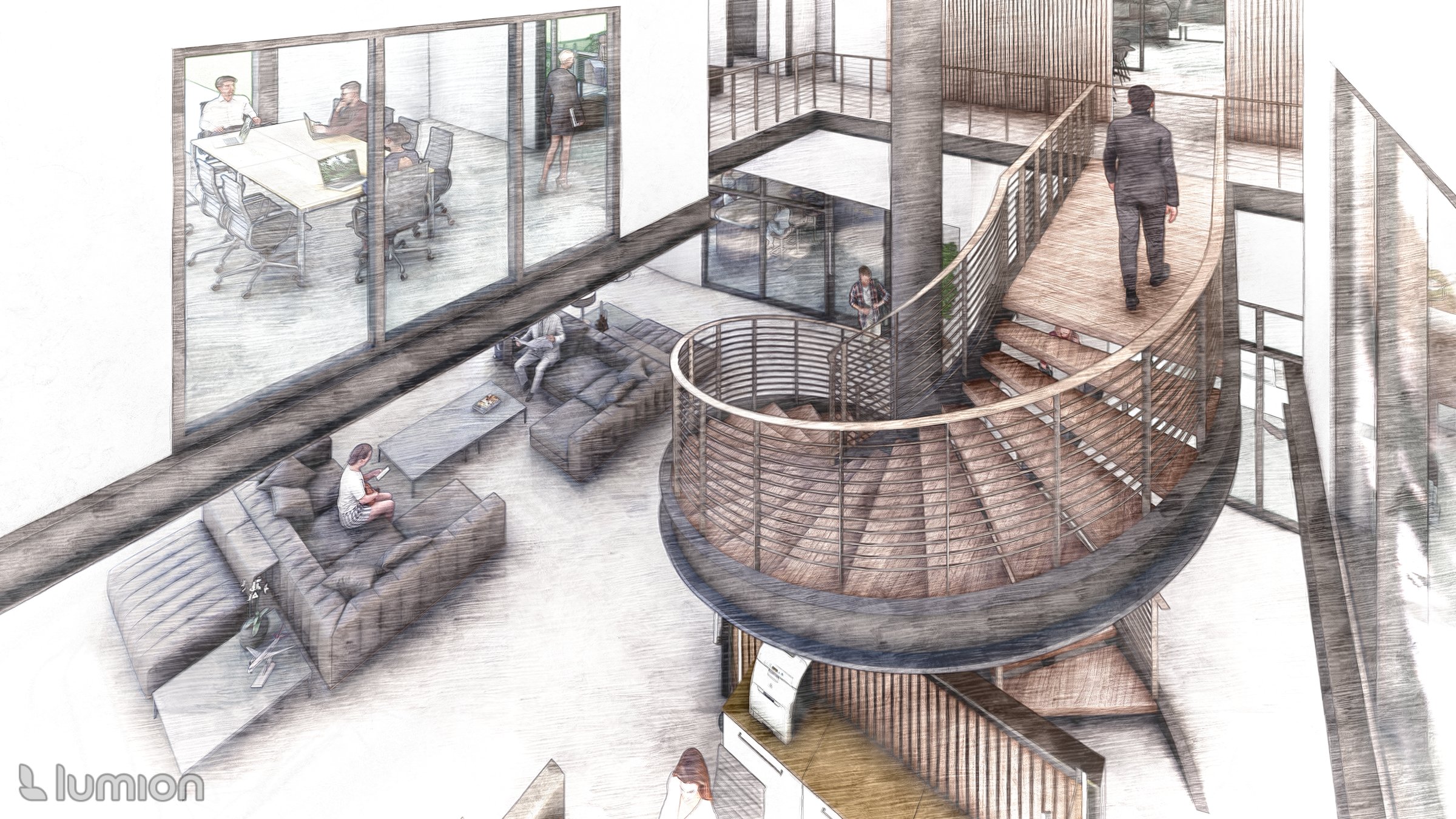
An interior study: the stair connecting lounge and mezzanine office levels.
A client's precision
Every project takes on something of its client, and this one had the good fortune of a client fluent in precision. Chris's refined sensibilities — informed by his life as a pilot, his interest in Swiss watchmaking, and his passion for photography — align closely with our own design values. Those three pursuits share a demand for thoughtful detail and exact proportion, and that shared appreciation ran through the project's decisions, from the discipline of the structure to the way daylight and view are composed for people waiting, working, and watching aircraft move.
For Santa Maria, and for the region
As the new home of Central Coast Jet Center, the building reflects a commitment to serving the Santa Maria community and the broader aviation community with pride and purpose. It is a facility shaped by operational needs and long-term service — a place where history, performance, and design come together to support everything from everyday flight operations to critical regional response. For our studio, it is also a proof of an idea we hold across all of our commercial architecture: that working buildings deserve real architecture, and that rigor and character are not competing goals.
You can see the full set of images on the Central Coast Jet Center project page, and read about our wider work in the area on our Santa Maria page. If you are planning an aviation, industrial, or commercial project of your own, we would be glad to talk.